
Technicians who cannot produce proof of certification when asked directly have already answered the more important question about whether the job should continue at all that day. Freezing in this moment is common, but it wastes the window where the most useful action can still be taken.
Knowing what to do next turns an uncomfortable situation into a manageable one, especially when a garage door service appointment already feels tense. This guide walks through the exact steps to take once certification cannot be confirmed on the spot, from the first pause to the final report if one becomes necessary.
Key Takeaways
- Pausing all work immediately remains the most important first step.
- Requesting credentials in writing closes the gap a verbal claim leaves open.
- Independent verification settles the question faster than continued conversation.
- Payment should never change hands until certification has been confirmed.
- Documentation gathered early strengthens any report filed later.
Steps to Take If Certification Cannot Be Confirmed
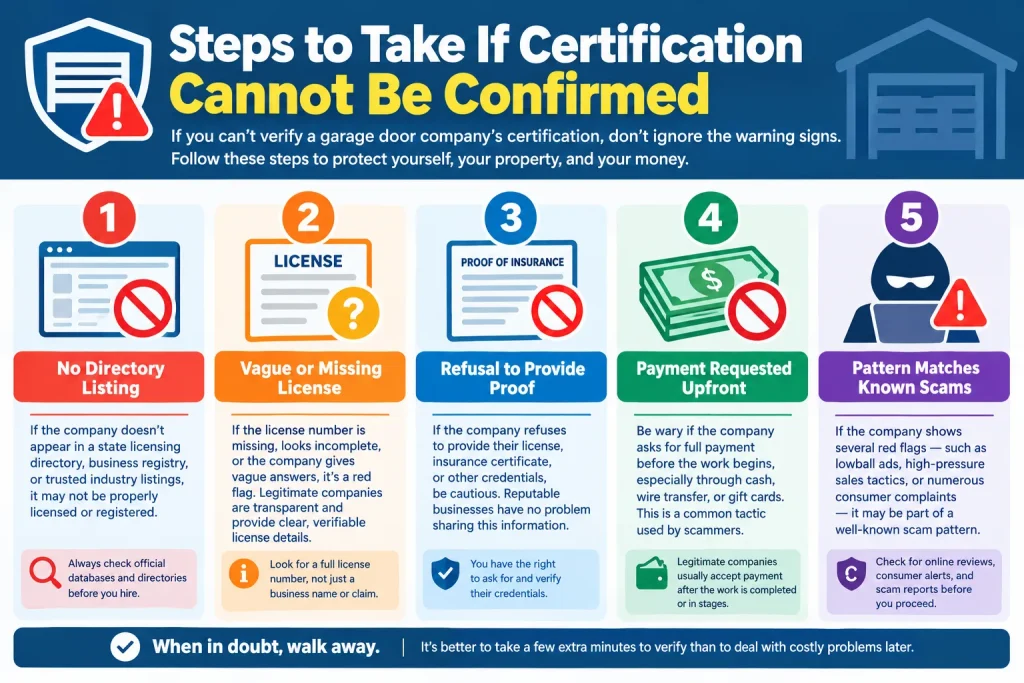
Missing certification calls for a specific sequence of actions rather than a single reaction, based on which warning pattern actually applies.
|
Situation |
What It Means |
Recommended Action |
|
No Directory Listing |
The company does not appear in the official IDA database |
Pause the appointment before work continues |
|
Vague or Missing License |
No verifiable license number provided on request |
Request the number in writing immediately |
|
Refusal to Provide Proof |
The company avoids or deflects verification requests |
Treat the refusal as confirmation of the problem |
|
Payment Requested Upfront |
Pressure to pay before any verification occurs |
Decline until credentials are independently confirmed |
|
Pattern Matches Known Scams |
Behavior mirrors documented scam tactics |
Document everything and consider filing a report |
To understand how this situation connects to the original check, read our guide on How to Check If a Garage Door Company Is IDA Certified, which walks through the exact steps for confirming a credential before hiring anyone.
Pause All Work Immediately
Stopping work the moment certification cannot be confirmed prevents complications that become harder to undo once work has already progressed.
These actions come first, before any conversation about payment:
- Stop the technician before dismantling springs, tracks, or openers.
- Avoid signing any paperwork or agreeing to a price on the spot.
- Ask the technician to step back while questions get resolved.
- Treat any pressure to continue as a reason to pause further.
- Remember that pausing causes no penalty for a legitimate garage door repair business.
Legitimate companies generally welcome a brief pause while questions get answered, since honest technicians have nothing to hide during that short delay.
Request Physical Credentials on the Spot
Asking for specific documentation shifts the conversation from a verbal claim to something that can actually be checked against a real record.
These details should be requested clearly and directly:
- The exact license number, not a general description.
- Proof of liability insurance covering the current job.
- Any manufacturer or industry certification mentioned earlier.
- Confirmation in writing rather than a spoken answer alone.
- A direct answer instead of a vague or evasive response.
Reluctance to provide these details usually confirms the concern well before any garage door installation appointment gets underway that day.
Verify the Details Independently
Checking claims against an outside, independent source removes the uncertainty that a conversation alone cannot settle on its own.
These checks confirm whether the claims hold up:
- Compare the license number against the state licensing database.
- Call the manufacturer directly if a brand affiliation was mentioned.
- Search the IDA directory for any certification claimed during booking.
- Confirm the business address through independent public records.
- Treat any mismatch as confirmation that something is not right.
A few minutes of independent verification settles more than continued conversation, even for routine garage door maintenance calls.
Protect Payment Before It Changes Hands
Payment decisions carry real weight once certification cannot be confirmed, so this step deserves the same caution as the verification itself.
These actions protect against financial loss:
- Refuse to pay in cash or provide a large deposit upfront.
- Use a credit card if payment becomes unavoidable, for dispute protection.
- Avoid signing a final invoice until credentials are confirmed.
- Request a written, itemized estimate before authorizing further work.
- Treat pressure to pay quickly as a reason to slow everything down.
To recognize this same pressure pattern in a broader context, read our guide on Signs a Garage Door Company Faked Its Certification, which explains how these tactics typically show up together during a booking call.
Document, Verify Elsewhere, and Report if Necessary
Gathering evidence and getting a second opinion closes the loop when the original complaint resolution process stalls or goes nowhere at all.
These steps close out the process properly:
- Take photos of any completed work, damage, or identification shown.
- Save every text message, email, and estimate exchanged during contact.
- Contact a fully licensed, certified company for a second opinion.
- Request a written assessment separate from the original company’s claims.
- File a complaint with the local consumer protection agency if warranted.
To confirm license standing through a separate, independent check, read our guide on How to Verify the License of a Garage Door Company, which explains exactly what documentation to request before scheduling anyone.
What Comes After Reporting an Uncertified Company
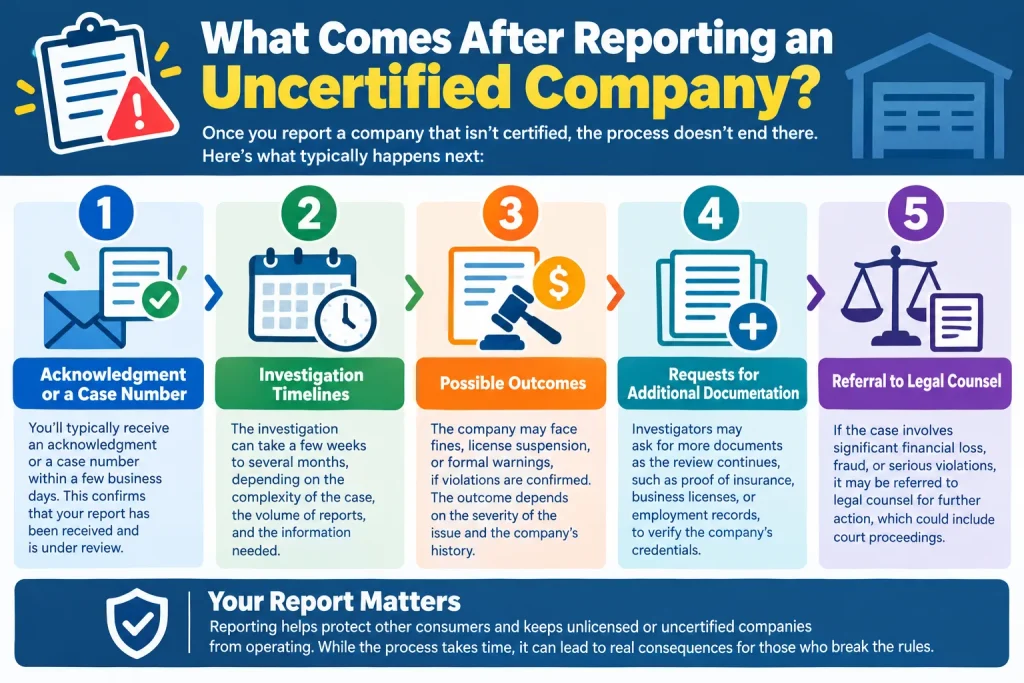
Reports take time to move through official review, and most cases need several weeks before reaching any real resolution or outcome.
Expect these general outcomes once a report gets filed:
- Acknowledgment or a case number within a few business days.
- Investigation timelines ranging from a few weeks to several months.
- Possible outcomes including fines, license suspension, or formal warnings.
- Requests for additional documentation as the review continues.
- Referral to legal counsel if the case involves significant financial loss.
Following up periodically on the case status tends to keep a complaint from being overlooked or delayed for too long.
The Right Response Starts the Moment Certification Fails
Pausing, verifying, and documenting a situation like this protects both the home and the ability to hold a company accountable, especially once money has already changed hands or work has begun. A calm, methodical response tends to produce a far stronger outcome than a rushed or emotional one made under pressure.
Amelia Overhead Doors staffs every appointment across Virginia with certified, verifiable professional technicians, so homeowners are not left facing this situation alone. Contact us or give us a call today to schedule service with a team that welcomes every certification question without hesitation.