
A company that claims IDA certification is not always telling the truth, and the gap between a real credential and a fabricated one often comes down to details most people never think to check. Scammers count on that gap, especially when a repair feels urgent and the conversation happens under pressure.
Rushed decisions made under pressure open the door to costly mistakes during any garage door service appointment, especially when trust is extended too quickly. This guide breaks down the warning signs that reveal a fabricated credential and what each one looks like in practice.
Key Takeaways
- Digital verification gaps, like a missing directory listing, often expose a fabricated claim within minutes.
- Certification tiers follow a strict progression, and skipping a required phase signals fraud.
- Logo quality and certificate formatting reveal forgeries once compared against genuine examples.
- Expired or mismatched dates on a certificate point to a lapsed or invented credential.
- Pressure to skip verification during scheduling often accompanies a fabricated claim.
Warning Signs of a Faked IDA Certification
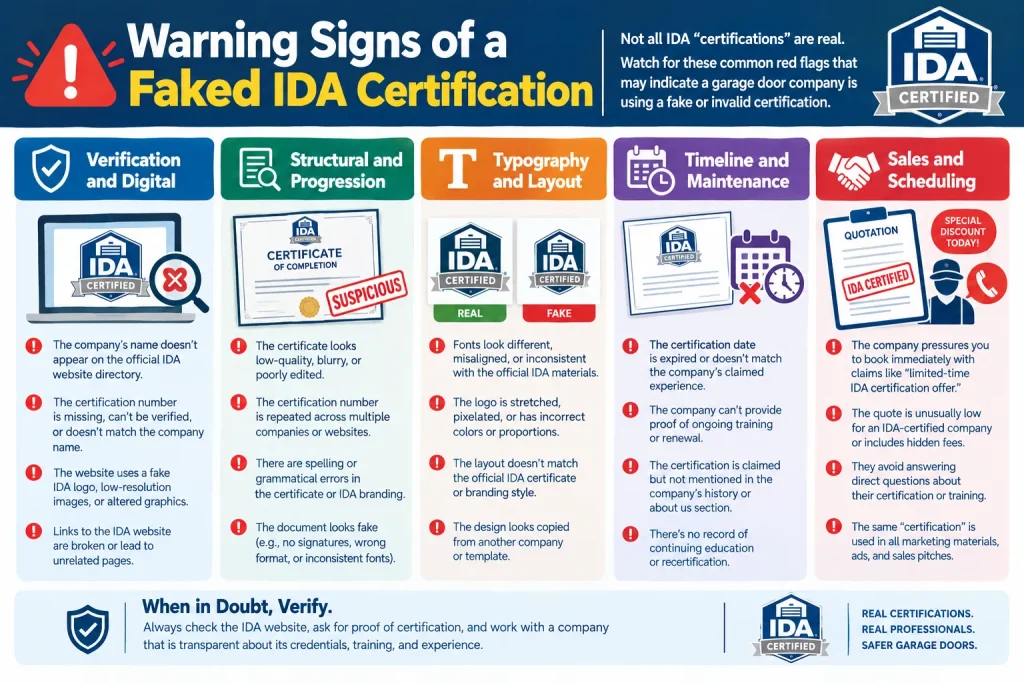
Fabricated certification claims tend to fall into a handful of recognizable categories, documented across independent scam reports from different regions.
|
Sign Category |
What It Looks Like |
Why It Signals Trouble |
|
Verification and Digital |
No listing in the official member directory |
Real certifications are always publicly searchable |
|
Structural and Progression |
Claiming an advanced tier without the required base level |
Certification tiers cannot be skipped legitimately |
|
Typography and Layout |
Blurry logos or mismatched fonts on the certificate |
Genuine certificates follow a consistent official template |
|
Timeline and Maintenance |
Expired dates or missing renewal history |
Active certification requires ongoing renewal |
|
Sales and Scheduling |
Refusing to show proof or rushing the appointment |
Legitimate companies rarely resist a verification request |
To confirm whether any of these categories apply to a specific company, read our guide on How to Check If a Garage Door Company Is IDA Certified, which walks through the exact steps for checking a credential from start to finish.
Verification and Digital Red Flags
Digital records offer the fastest way to confirm whether a garage door repair company’s certification claim actually holds up.
These details often expose a fabricated digital credential:
- Absence from the official IDA directory under the company name.
- Verification links or QR codes that open a flat image, not a live record.
- A verification URL on a slightly altered domain, not the official site.
- A missing or invalid certificate number, off standard format.
- No willingness to provide a certificate number for independent checking.
A missing digital footprint rarely appears alone and usually points to a broader pattern worth investigating further before scheduling any work.
Structural and Progression Discrepancies
Certification programs follow a strict order, and claiming an advanced level without the required foundation is a common shortcut scammers take.
Watch for these gaps in how the credential was supposedly earned:
- Claiming an advanced tier without completing the required entry-level phase.
- Advertising a specialty designation without holding the base certification for any garage door installation.
- Referencing a regional training center with no verifiable link to the association.
- Certification credited to a chapter or region with no authorized presence.
- A credential progression that does not match how the program actually works.
Legitimate technicians can usually explain their certification path clearly, since the process itself is well documented and consistent.
Typography, Logo, and Layout Red Flags
Genuine certificates follow a consistent visual template that becomes noticeably different once a forged version gets compared beside it.
These visual details often reveal a manufactured document:
- A logo that appears pixelated, stretched, or lower resolution than official versions.
- Uneven spacing, mismatched fonts, or inconsistent baselines in the text.
- Vague or invented terminology instead of the association’s actual titles.
- A signature block that looks pasted in or shows compression artifacts.
- Layout details that differ from certificates confirmed genuine, useful before scheduling any service, such as garage door maintenance.
Side-by-side comparison against a verified example remains the fastest way to notice these visual inconsistencies during any initial inspection.
Timeline and Maintenance Anomalies
Active certification depends on ongoing renewal, so a credential frozen in time often signals it has lapsed or was never real to begin with.
These date-related details frequently expose a problem:
- An expiration date that has already passed without any renewal on record.
- A certification issue date that does not align with the company’s known history.
- No continuing education or renewal activity reflected in the association’s records.
- A renewal cycle that does not match the standard schedule the credential requires.
- Dates on the certificate that shift depending on who is asked.
To confirm current license standing as a separate check from certification dates, read our guide on How to Verify the License of a Garage Door Company, which explains exactly how that check works and what documents to request before scheduling.
Sales and Scheduling Red Flags
Scheduling behavior often reveals more about legitimacy than the certificate itself, a pattern reflected in common scam patterns.
These tactics frequently accompany a fabricated certification claim:
- Refusing to show the physical or digital certificate before work begins.
- Rushing the appointment before there is time to verify anything shown.
- Discouraging any attempt to photograph or write down the certificate details.
- Offering a discount specifically tied to skipping the verification step.
- Reacting with visible irritation when asked to confirm certificate details.
To learn exactly what to do once a company cannot produce proof, read our guide on What to Do If a Garage Door Company Is Not Certified?, which walks through the steps that follow once this gap becomes clear.
Confirming Suspicion Before Making Any Final Decision
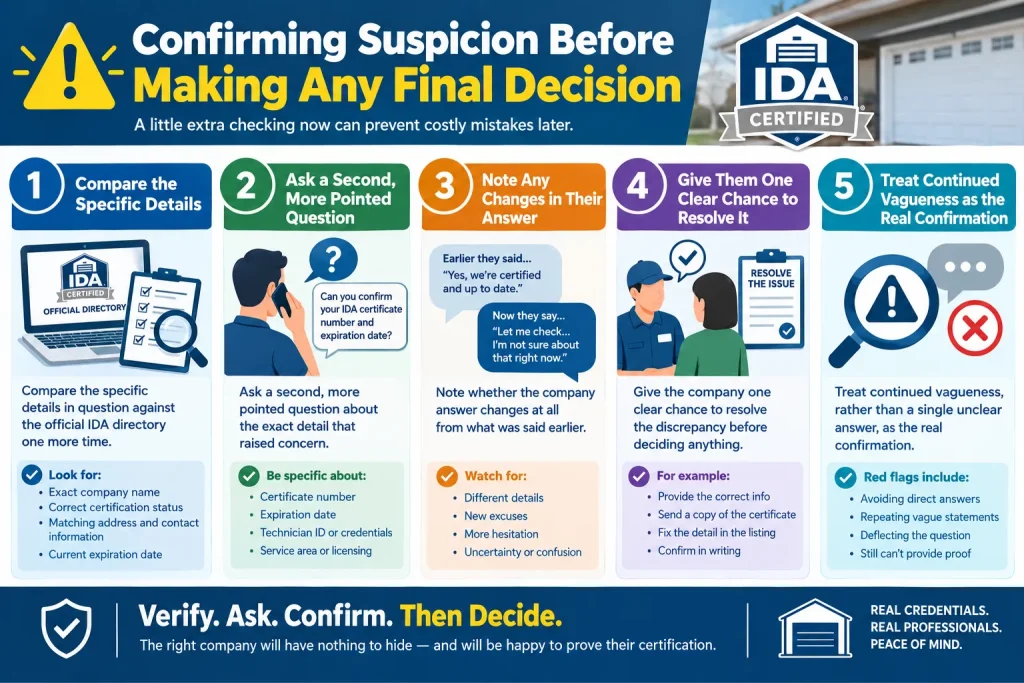
Suspecting a fake credential is not the same as confirming it, and that gap is exactly where a hasty decision under pressure tends to cause the most regret later.
Take these steps before treating a suspicion as a confirmed fact:
- Compare the specific details in question against the official IDA directory one more time.
- Ask a second, more pointed question about the exact detail that raised concern.
- Note whether the company answer changes at all from what was said earlier.
- Give the company one clear chance to resolve the discrepancy before deciding anything.
- Treat continued vagueness, rather than a single unclear answer, as the real confirmation.
Consistency in a company answers across multiple direct questions says more about legitimacy than any single response ever could.
One Verification Check Can Expose a Fake Credential
Fabricated certifications rely on people accepting a claim at face value rather than checking it against an outside source that can confirm or deny it. Warning signs like these tend to overlap in the same company, so noticing one usually means others are worth investigating too.
Amelia Overhead Doors backs every technician across Virginia with certification that holds up the moment anyone asks to see it, without hesitation or delay. Contact us or give us a call today to schedule service with a team that welcomes every verification question and treats it as routine.