
A homeowner facing a broken spring or a jammed opener rarely thinks to ask about industry credentials before letting a technician start work, especially when the repair feels urgent. That single question, though, often separates a legitimate repair from a costly mistake that leads to disputes and unresolved damage.
Scammers count on that hesitation, especially when a garage door service gets booked in a rush after something breaks without warning. This guide explains what IDA certification means, how to verify it before hiring anyone, and what to watch for if a company can’t provide proof when asked.
Key Takeaways
- IDA membership and IDEA accreditation are not the same credential, and confusing the two costs homeowners real money.
- The official IDA directory lets anyone confirm a company’s status in a few minutes.
- Fake certification claims often rely on copied logos and invented member numbers.
- If a company can’t produce proof of certification when asked, don’t trust it with the job.
- Hiring a certified company protects warranties, safety features, and long-term costs tied to the entire garage door system.
What Does IDA Certification Actually Mean?
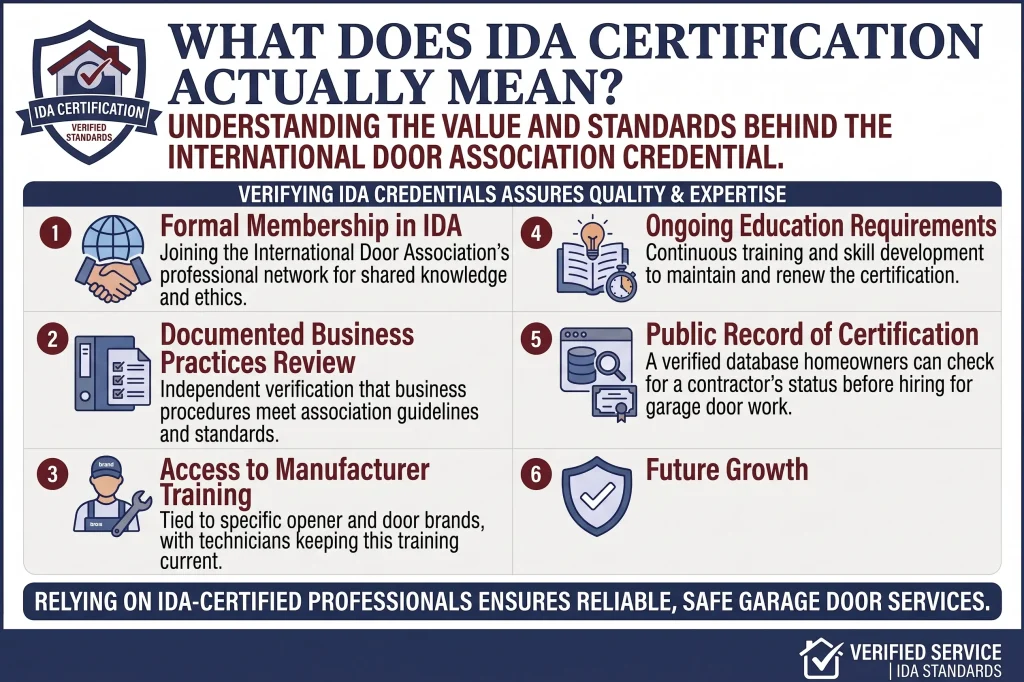
Garage door companies with IDA certification meet specific industry standards that separate them from independent operators working without oversight.
These standards cover the areas that matter most once work begins:
- Formal membership in the International Door Association’s professional network.
- Documented business practices reviewed against association guidelines.
- Access to manufacturer training tied to specific opener and door brands, backed by professional technicians who keep that training current.
- Ongoing education requirements to keep the credential active.
- A public record that homeowners can check before hiring anyone for garage door installation work.
Professionalism backed by a real credential often shows up in how a company handles pricing, scheduling, and the paperwork left behind after the job.
How Does IDA Membership Differ From IDEA Accreditation?
Homeowners often assume any mention of “IDA” guarantees the same level of vetting, but membership and accreditation actually confirm very different things.
|
Factor |
IDA Membership |
IDEA Accreditation |
|
What It Requires |
Paid dues and basic business registration with the association |
Passing formal exams covering installation, safety, and repair standards |
|
What It Proves |
The company has joined the industry’s professional network |
Technicians met a tested standard of technical knowledge |
|
How to Verify It |
Search the company name in the public member directory |
Look for the specific IDEA accreditation badge or certificate number |
The credential gap usually surfaces only after checking the official directory, which could have confirmed the real status beforehand.
Steps to Verify a Garage Door Company’s IDA Certification
Visit the Official IDA Website
Confirming a company’s status starts at the official source, not on claims made over the phone or printed on the side of a truck.
Here is where that verification process begins:
- Open a browser and search for the International Door Association by name.
- Confirm the web address matches the organization’s official domain.
- Avoid third-party sites that claim to mirror the association’s directory.
- Bookmark the page if checking multiple companies during the search.
- Treat this step as the starting point, not the final confirmation.
Homeowners who start at the wrong website risk pulling outdated or entirely fabricated membership information without realizing it.
Search the Find a Pro Directory by Location
Once a homeowner knows exactly where to look, finding the right search tool on the official site takes only a moment.
The directory search works through these steps:
- Find the “Find a Pro” or “Find a Qualified Professional” link in the main menu.
- Enter the company’s ZIP code or city and state into the search field.
- Review the list of active members that appears for that area.
- Cross-check the company name exactly, since similar names sometimes appear.
- Note whether the listing includes a phone number matching the one advertised.
Garage door repair decisions carry less risk once a homeowner confirms the company actually appears in this active member database.
Check for IDEA Accreditation Status
Membership alone does not confirm technical competence, so this step separates a listed company from a genuinely accredited one.
These details reveal whether IDEA accreditation applies:
- Look for a specific IDEA badge or seal on the directory listing.
- Confirm the accreditation has not expired or lapsed.
- Check whether the accreditation covers residential work, commercial work, or both.
- Compare the listed scope against the type of job being scheduled.
- Ask the company directly to explain what their accreditation covers if unclear.
Accreditation status changes over time, so a listing checked months ago may no longer reflect the company’s current standing.
Ask the Dispatcher to Confirm the Local Office
A phone call fills in details an online directory listing cannot always capture, especially about who is actually running the local office.
These questions help confirm the office is legitimate:
- Request the full legal business name tied to the local office.
- Ask for the physical address, not just a service area description.
- Confirm how long that specific office has operated under the current name.
- Ask whether the dispatcher can provide a membership or license number on request.
- Note any hesitation or vague answers during this part of the call.
Independent operators sometimes borrow a recognizable regional name to appear more established than they really are.
Verify Individual Technician Credentials
The company as a whole might carry certification even when a specific technician arriving at the door does not meet the same standard.
To close that final gap, homeowners can take this last step:
- Ask for the name of the technician assigned to the appointment in advance.
- Request confirmation that this specific person holds relevant training or licensing.
- Compare the technician’s stated credentials against what the company advertises.
- Save the technician’s name for reference if a dispute comes up later.
- Treat a refusal to share this information as a reason to pause the appointment.
To confirm licensing details specific to the technician arriving at the home, read our guide on How to Verify the License of a Garage Door Company, which walks through exactly how that check works before confirming any appointment.
Warning Signs a Garage Door Company Faked Its Certification
Fake certification claims often rely on a small set of tricks that repeat across scam attempts, making them easier to spot once homeowners know the pattern.
These details often expose a fabricated credential:
- A membership number that returns no result when searched in the directory.
- A certification logo that looks slightly different from the official version.
- Vague or shifting answers when asked which local office holds the credential.
- No physical address tied to the company beyond a service area listed online.
- Pressure to schedule immediately instead of allowing time to verify anything.
To recognize the full pattern early, read our guide on Signs a Garage Door Company Faked Its Certification, which breaks down the specific red flags that separate real credentials from convincing fakes.
Next Steps If a Garage Door Company Cannot Prove Certification
A company that cannot produce proof of certification when asked directly has already answered the more important question: whether the job should move forward.
These steps apply once that gap becomes clear:
- Pause the appointment before any work begins, or payment changes hands.
- Ask for a membership or accreditation number you can verify independently.
- Search the official member directory directly instead of relying on what the company claims.
- Contact the local office listed to confirm the technician’s assignment.
- Document the interaction in case you need to file a report later.
Reviewing common scam tactics helps homeowners recognize patterns early, well before a technician ever reaches the driveway to start work.
Why Does Hiring an IDA Certified Company Matter?
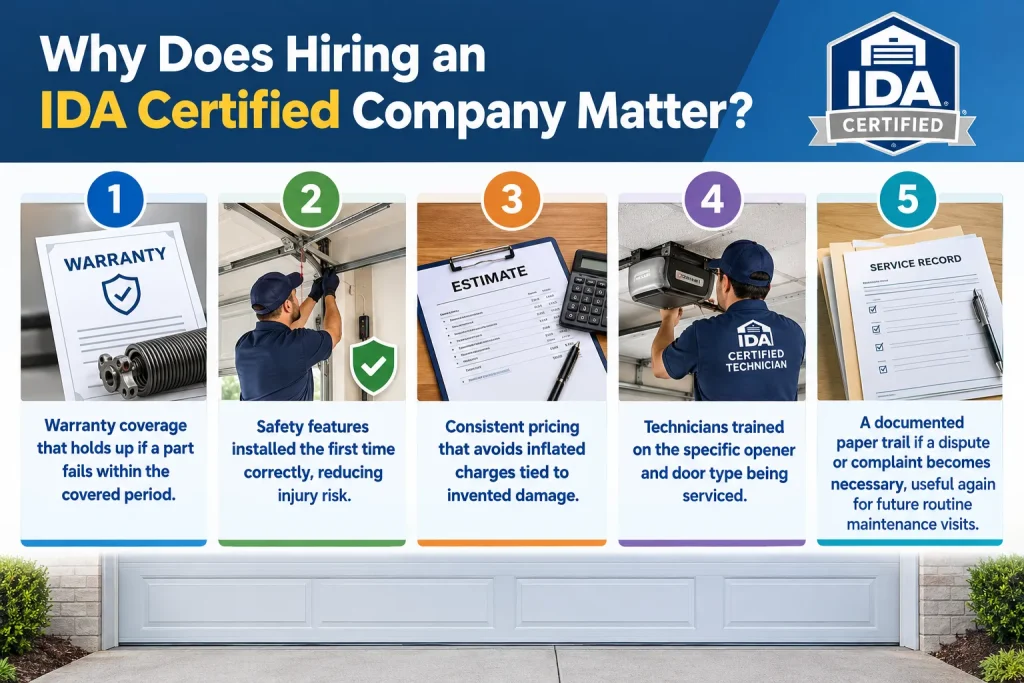
Certification affects more than a single repair bill, including safety, warranty coverage, and how a garage door replacement is handled if something fails early.
These outcomes depend directly on that certification:
- Warranty coverage that holds up if a part fails within the covered period.
- Safety features installed the first time correctly, reducing injury risk.
- Consistent pricing that avoids inflated charges tied to invented damage.
- Technicians trained on the specific opener and door type being serviced.
- A documented paper trail if a dispute or complaint becomes necessary, useful again for future routine maintenance visits.
Peace of mind after any repair depends less on the price charged and more on whether the company doing the work ever had the credentials to begin with.
Certification Confirms Who Is Really Working on Your Garage Door
A homeowner who takes a few minutes to verify IDA certification avoids the far longer process of disputing a bad repair, chasing a warranty claim, or arguing over damage after the fact. That small effort holds up whether the job involves a single opener repair or a full system replacement.
Amelia Overhead Doors sends certified, trained technicians to every appointment across Virginia, so homeowners never have to guess who is working on their garage door. Contact us or give us a call today to schedule service with a team that treats certification as the baseline, not the exception.